The Titanic and the Media: How Telegrams, Newspapers and Testimonies Shaped a Tragedy
By Sanija Klavinska
University of Calgary
COMS 381 Winter 2025 – Dr. A. Rudd
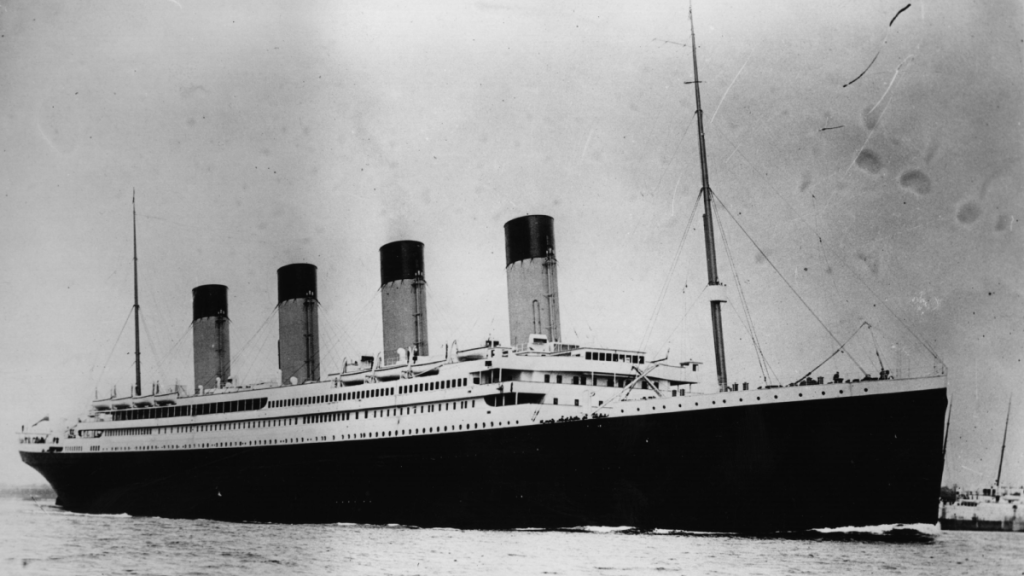
Figure 1. The Titanic in the water (Porter, 2023)
Introduction
The tragedy of one of the greatest ships part of the White Star line – the RMS Titanic– in the early 20th century (Marshall, 2019) caused a turning point in how global news was communicated. The ship had departed from Southampton, England, for New York City on April 10, 1912. What no one could have expected was that a ship that was said to be one of the best of British engineering (Smith, 1994) and “unsinkable” (“Sinking of the Titanic”, 1935, p. 13), could have tragically sank due to hitting an iceberg, only four days later on April 14 (Gavin & Zarr, 2012). With such surprising news spreading quickly, it was no wonder that people wanted to know what happened. The question is though- on what medium did people get the information and was it accurate?
The sinking of the Titanic in 1912 was communicated through telegrams, newspapers, and survivor testimonies, each shaping public perception in different ways. Telegrams delivered quick but sometimes conflicting information, newspapers often focused on exaggerated information over accuracy, and survivor testimonies offered emotional depth that humanized the tragedy. As media evolved, films, social media, and online discussions have continued to influence how the disaster is remembered. Comparing the media coverage of 1912 with how the Titanic might be reported in 2025 reveals how advancements in communication influence not only the speed and accuracy of reporting, but also how historical events are framed, shared, and remembered by the public.
Figure 2. Real Titanic footage showing the ship departing Belfast, 1911–1912. Adapted from Titanic Real Footage: Leaving Belfast for Disaster (1911–1912) by British Pathé, 2014, [Video], YouTube. https://www.youtube.com/watch?v=05o7sOAjtXE
Framing a Tragedy: The Titanic in Early 20th-Century Media
When the Titanic sank on April 14, 1912, people around the world turned to every available medium— telegrams, newspapers, and survivor accounts—in search of answers about what had happened.
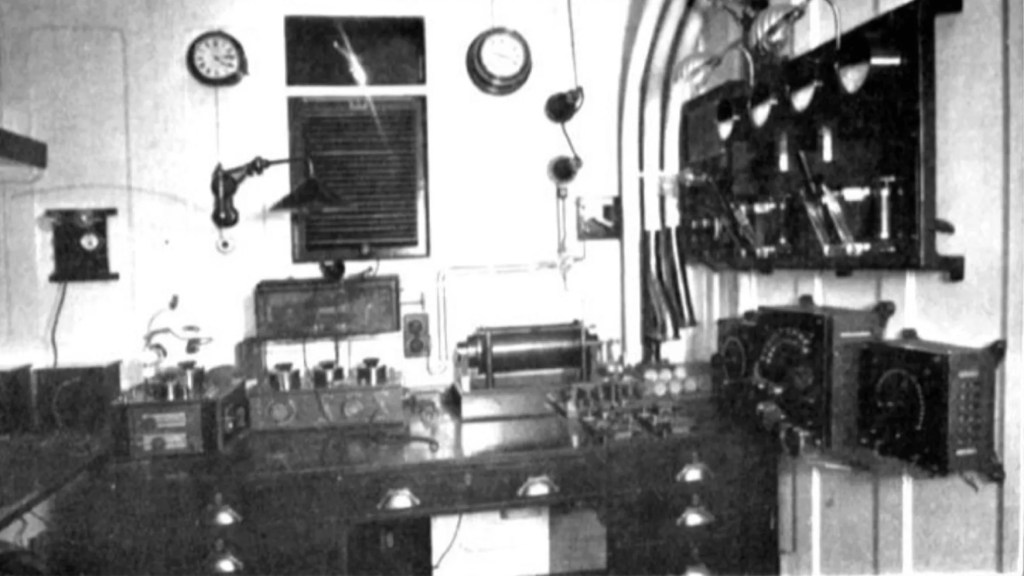
When the Titanic began to sink, the ship’s wireless operators were among the first to act, sending out urgent SOS messages. Thanks to wireless telegraphy—specifically the Marconi system—it was possible to achieve “rapid point-to-point communication” (Heyer, 2012, p. 24). Invented by Guglielmo Marconi, this system promised that ships could be tracked like trains, allowing their movements to be monitored. The Titanic, equipped with the latest wireless technology, used the call sign MGY, making it easily identifiable.
The adoption of the SOS call letters was significant; the system could manage multiple incoming transmissions despite interference from nearby vessels, and the Titanic disaster helped popularize the use of SOS internationally (Heyer, 2012, p. 32). However, the efficiency of this system was sometimes compromised. Prior to the Titanic’s voyage, false alarms had frequently congested maritime radio traffic, delaying communication during emergencies (Heyer, 2012, p. 34).
One widely discussed controversy concerns the fact that the Titanic reportedly received at least six iceberg warnings before the collision (Heyer, 2012, p. 36). Despite these alerts, Captain Edward Smith did not reduce the ship’s speed, as the weather conditions were calm and visibility was clear. Many believe the captain felt pressure to meet the ship’s scheduled arrival time, and slowing down would have diminished public excitement surrounding the voyage (Heyer, 2012, p. 38).
Further debate surrounds the SS Californian, which sent the last wireless warning at 11:00 p.m.—just 40 minutes before the Titanic struck the iceberg (Gavin & Zarr, 2012). Critics question whether the Californian’s crew, especially radio operator Cyril Evans, could have done more. Evans had signed off shortly before the collision, reportedly due to exhaustion and long hours with minimal pay (Heyer, 2012, p. 40). Had he still been on duty, the distress calls might have been received sooner. Some speculate that nearby ships with visible lights might have been close enough to assist before the RMSCarpathia arrived nearly two hours after the Titanic began to sink (Kern, 1983, p. 66).
By 1:20 a.m., wireless stations in Newfoundland had already received news of the disaster, and by early morning, the tragedy had spread around the world (Kern, 1983, p. 66). Although imperfect, wireless telegraphy allowed for faster communication than had ever been possible before. Even with conflicting details, telegrams opened up new possibilities for long-distance messaging and made it possible for the public to learn about the Titanic with minimal delay.
Figure 3. The Marconi system on the Titanic (Carmoodie, 2023)
Newspapers allowed the public to read stories of heroism, selfishness, and cowardice aboard the Titanic. Publications like The New York Times, The Evening Star, The Sydney Morning Herald, and The Vancouver World, among others, quickly released information to the public using bold visuals, dramatic headlines, and powerful imagery—although these reports were not always accurate (Library of Virginia, n.d.). With the flood of coverage from so many different outlets, each newspaper often told a slightly different story, shaping public perception in varied ways depending on what source was read. For example, readers of The Sydney Morning Herald may have believed that the men on board displayed the most bravery, as reports emphasized how they sent women and children to the lifeboats first, not knowing if there would be enough space for themselves (Gregson, 2008). If one had read the Vancouver World they would have read the headline:
“Titanic Sinking ; No Lives Lost”
(Mackie, 2021)
Figure 4. The Vancouver World newspaper published on April 15, 1912 (Mackie, 2021)
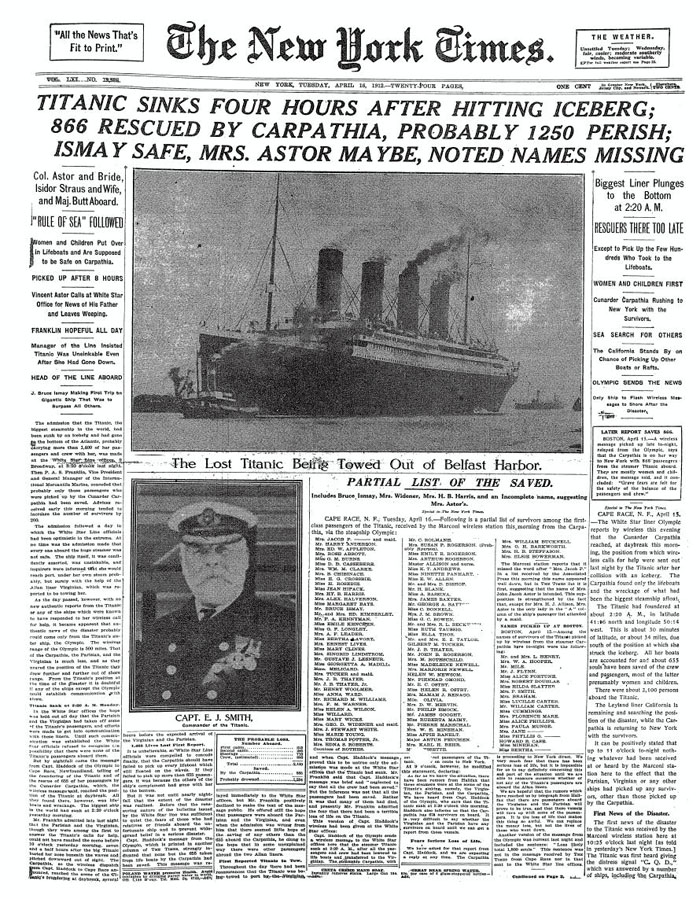
This headline is one example of the misinformation that circulated, leading many to believe that the Carpathia had saved all passengers—when in reality, that was not the case. There was significant inconsistency across newspapers regarding the number of lives lost and saved, especially as the exact death toll remains uncertain (Gilder Lehrman Institute of American History, n.d.). The New York Times reported, “866 Rescued By Carpathia, Probably 1250 Perish” (see Figure 5), while The Evening Star stated only “Hundreds Of Lives [Were] Lost” (see Figure 6). Although these newspapers were able to release information in less than a day, their reports were not always accurate or reliable. While newspapers played a key role in keeping the public informed about the disaster, they also contributed to confusion and uncertainty, making it difficult for readers to discern the truth.
Figure 5. The New York Times newspaper on Tuesday, April 16, 1912 (ABC News, 2012)Figure 6. The Evening Star newspaper on Monday, April 15, 1912 (Donnelly, 2020)
Amid the spread of misinformation, some individuals shared personal accounts to clarify what truly occurred aboard the Titanic. Several crew members wrote testimonies asserting that “the conditions of sea and air on that night were calmer than any they had ever experienced” (Heyer, 2012, p. 39), which they cited as a reason for not slowing the ship down. Renée Harris, a high-society passenger, recounted how slipping on “the grease of a cupcake” led to her unexpected survival—though she hesitated to board a lifeboat because it meant leaving her husband behind (The Testimony of a Titanic Survivor, 2023). Another account came from first-class passenger Dr. Washington Dodge, who described the ship’s final hours, including the difficulty of being lowered into the water near the massive condenser pump. He also recalled witnessing the Titanic submerge and the moment the lights went out (Gilder Lehrman Institute of American History, n.d.). These and other survivor testimonies conveyed the fear and heartbreak of that night, offering an emotional depth that helped humanize the tragedy and preserve its memory through lived experience.
Figure 7. Eyewitness excerpt of the sinking of the Titanic, April 15, 1912, by Washington Dodge (The Gilder Lehrman Institute of American History, n.d.)
Together, these three mediums portrayed the Titanic disaster as both a story of hardship and of heroism. Each form of communication shaped public perception differently, resulting in multiple, and sometimes conflicting, narratives about what truly happened that night.
Modern Representations of the Titanic in Digital and Popular Media
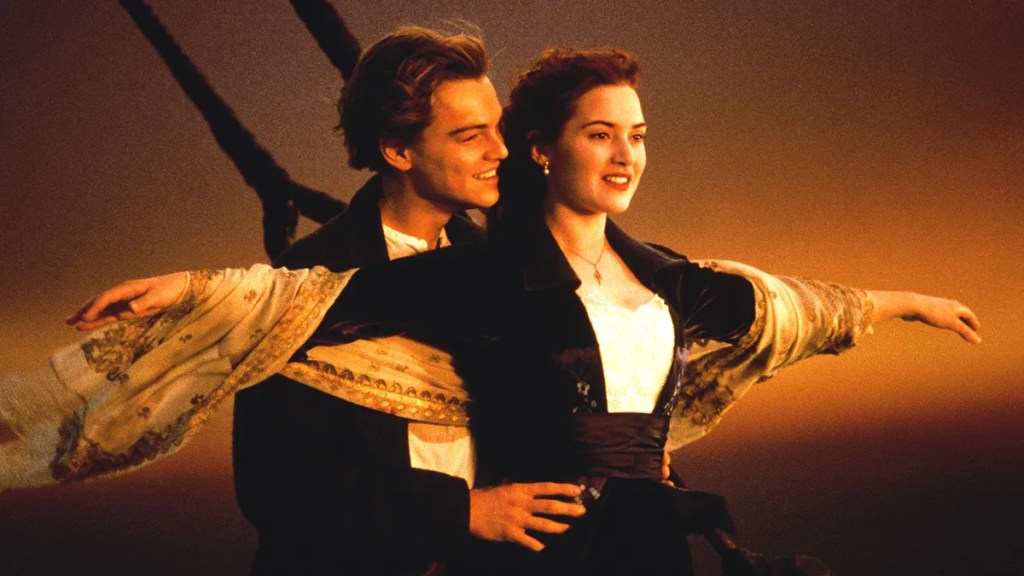
Over the past century, the story of the Titanic has been retold and reimagined through film, digital platforms, and social media—all of which continue to shape public memory and emotional engagement with the tragedy. The 1997 film Titanic, starring Kate Winslet and Leonardo DiCaprio (Eldridge, 2025), reignited global interest in the historical event. Praised for its emotional depth and attention to historical detail, the film has contributed significantly to the enduring cultural memory of the disaster. Director James Cameron invested considerable effort into ensuring historical accuracy, incorporating real-life figures such as Captain Edward Smith and opening the film with actual underwater footage of the wreck (Eldridge, 2025). The film’s success led many viewers to see it multiple times (Eldridge, 2025), drawn in by the immersive visuals and emotionally charged storytelling (New York Times Company, 2011). Despite widespread knowledge of the ship’s fate, audiences remained captivated—largely due to Cameron’s meticulous set design and the fictionalized love story at the film’s center. This blend of historical authenticity and emotional fiction created a powerful narrative that reshaped how the Titanic is remembered, evoking sorrow not only for the lives lost, but also for the love story that never truly existed (Howells, 1998).
Figure 8. Jake holding Rose on the ship’s bow (Lekic, 2024)
With the rise of social media, the story of the Titanic continues to be shared and reimagined through platforms such as Twitter (now X), where accounts like @100Titanic and @TitanicRealTime live-tweet the ship’s final hours in real time. Archival footage resurfaces on YouTube, and historic photographs are widely circulated on Instagram (Cloutier, 2012). On TikTok, creators post facts, theories, and even conspiracies about the ship’s fate, drawing in audiences who are curious about different aspects of the event and its legacy.
Online discussions also take place on platforms like Reddit, where users engage in conversations and share personal reflections. One popular thread, titled “What is the most tragic OR incredible story from the Titanic?” received over 1,000 comments (Crafterlaughter, 2023). Comment sections on YouTube and TikTok also provide spaces for public dialogue, allowing users to respond to and reinterpret the Titanic story in diverse ways.
Modern representations—both factual and speculative—have introduced new narratives about what happened on the night the Titanic sank. While these stories sometimes contribute to the spread of misinformation, they also demonstrate how digital platforms keep the disaster present in public consciousness. More than a century later, these forms of engagement continue to shape how the tragedy is remembered, discussed, and understood.
Then vs. Now: How the Titanic Would Be Reported in 2025
If the Titanic sank today, the public would learn about it almost instantly—unlike the slow and inconsistent coverage seen in 1912. Real-time updates would flood platforms like X , Instagram, and TikTok, with hashtags such as #Titanic2025 or #TitanicBreakingNews trending within minutes. This speed of communication would alert global audiences to the disaster almost immediately, with news outlets providing live coverage, push notifications, and breaking news alerts. These developments could increase the accuracy of the situation, as footage and information would be shared directly by those witnessing the event.
In 2025, with most passengers carrying smartphones, individuals on board could take photos and videos, livestream the unfolding events, and send instant messages to loved ones. Eyewitness accounts would no longer rely on memory or interviews—they would be visual, real-time, and globally accessible. This level of immediate communication could also lead to a faster emergency response, potentially increasing the chances of survival. Real-time location data, distress signals, and visual evidence shared on social media could help rescue teams act more efficiently than was possible in 1912.
Unlike in 1912, when fragmented reports and delayed information shaped public understanding, today’s digital media would construct the narrative in real time—blending immediacy, emotion, and viral content. This would fundamentally change how the Titanic tragedy is recorded, interpreted, and remembered. These evolving forms of media would not only transform how quickly the story spreads, but also influence the emotional tone, public response, and long-term cultural significance of the event.
Conclusion: Media, Memory, and the Legacy of the Titanic
Over a century later, the Titanic remains one of the most widely discussed historical disasters—not only due to the tragedy itself, but because of how it has been represented across different forms of media. From the fast but often conflicting telegrams, dramatic newspaper headlines, and emotional survivor testimonies of 1912, to the films, social media, and online forums of today, each generation has contributed to reshaping public understanding and memory of the event. Media developments have transformed the public’s engagement with history, affecting how events are framed, emotionally processed, and preserved in cultural memory. If the Titanic were to sink in the present day, the coverage would be shaped by real-time updates, eyewitness media, and viral content—demonstrating the powerful role of modern platforms in shaping collective responses to disaster. The tragedy of the Titanic reveals that the way historical events are communicated can profoundly shape their legacy, emphasizing the need to examine how different mediums influence public memory.
Smith, D. (1994). Exploring the myth: The sinking of the Titanic. Industrial & Environmental Crisis Quarterly, 8(3), 275–288. https://doi.org/10.1177/108602669400800306



 April 11,2025 Word Count (without Citations and figure captions):1876